


Manufacturing Process
The manufacturing process of equal diameter tee mainly includes the following:
Extrusion molding and hot pressing are commonly used to produce tee fittings with larger diameters and thicker walls. During the heat treatment process, the original metal is heated to an appropriate temperature range and then subjected to plastic deformation through a mold to form the desired T-shape. For tees with smaller diameters and thinner wall thicknesses, processes such as cold extrusion and cold bending are more commonly used. These cold working methods allow metals to maintain high hardness and strength properties, although the manufacturing process is relatively more complex. In addition, the production of tees involves various forms of welding processes, including butt welding and fillet welding. Among them, butt welding is the main welding method for manufacturing equal diameter tees, which can ensure a firm connection between the tees and the pipeline system.
Dimensions Butt welding Equal Tee ASME B16.9
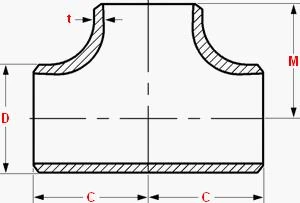
|
NPS |
O.D. |
Center to End |
Center to End |
|
1/2 |
21.3 |
25 |
25 |
|
3/4 |
26.7 |
29 |
29 |
|
1 |
33.4 |
38 |
38 |
|
1.1/4 |
42.2 |
48 |
48 |
|
1.1/2 |
48.3 |
57 |
57 |
|
2 |
60.3 |
64 |
64 |
|
2.1/2 |
73 |
76 |
76 |
|
3 |
88.9 |
86 |
86 |
|
3.1/2 |
101.6 |
95 |
95 |
|
4 |
114.3 |
105 |
105 |
|
5 |
141.3 |
124 |
124 |
|
6 |
168.3 |
143 |
143 |
|
8 |
219.1 |
178 |
178 |
|
10 |
273 |
216 |
216 |
|
12 |
323.8 |
254 |
254 |
|
14 |
355.6 |
279 |
279 |
|
16 |
406.4 |
305 |
305 |
|
18 |
457 |
343 |
343 |
|
20 |
508 |
381 |
381 |
|
22 |
559 |
419 |
419 |
|
24 |
610 |
432 |
432 |
|
26 |
660 |
495 |
495 |
|
28 |
711 |
521 |
521 |
|
30 |
762 |
559 |
559 |
|
32 |
813 |
597 |
597 |
|
34 |
864 |
635 |
635 |
|
36 |
914 |
673 |
673 |
|
38 |
965 |
711 |
711 |
|
40 |
1016 |
749 |
749 |
|
42 |
1067 |
762 |
711 |
|
44 |
1118 |
813 |
762 |
|
46 |
1168 |
851 |
800 |
|
48 |
1219 |
889 |
838 |
Dimensions are in millimeters unless otherwise indicated.
Wall thickness (t) must be specified by customer.
Applications
Isometric tees are widely used in various industrial fields, such as petroleum, chemical, natural gas, electric power, heat, ships, urban engineering and so on. In these fields, isometric tees are used to connect piping systems and realize the functions of medium diversion and merging.


