


Features and Advantages
Because of its superior flexibility and sealing properties, soft joint flanges offer better sealing properties to prevent medium leakage. Soft joint flanges can absorb displacement and vibration in pipe systems, and thus reduce stress and damage to the pipe system. The flexible joint flange is applicable to all kinds of medium and temperature, and can satisfy the requirements of different industry. Compared with the welded flange, the installation of the soft joint flange is relatively simple and does not require complicated welding.
Application Scenario
Ring-type joint flanges is widely used in piping systems in petroleum, chemical, shipbuilding, pharmaceutical, metallurgical and other industries. Especially in the working environment that needs to withstand large displacement, vibration and temperature change, Soft joint flange is favored for its good flexibility and sealing performance.
What is Ring-Type Joint (RTJ)
Ring-type joint (RTJ) flanges are a variation of the raised face flange design. RTJ flanges are typically used for more severe applications, particularly for high pressure systems, and/or high temperature systems (>750⁰C / 1,382⁰F). It is possible to use RTJ flanges across all pressure classes, but they are typically used for class 900 and above.
The difference between an RTJ flange and a raised face flange is the way a seal is obtained. Metal gaskets (hard) are used with RTJ flanges, whilst raised face gaskets use soft or semi-metallic gaskets. There are three main ring type joint groups, these are R, RX and BX; we will focus on the R type joint because it is by far the most common.
R-type RTJ gaskets are circular in shape with an oval or octagonal shaped profile/body; the octagonal profile obtains the most efficient seal and is the more modern design. A groove is machined into the face of an RTJ flange and the associated gasket is installed into this groove. When the flange is assembled, the two mating faces compress the gasket until it deforms and a metal to metal seal is formed. If the flange is assembled correctly, the two mating RTJ flanges should not come into physical contact with each other
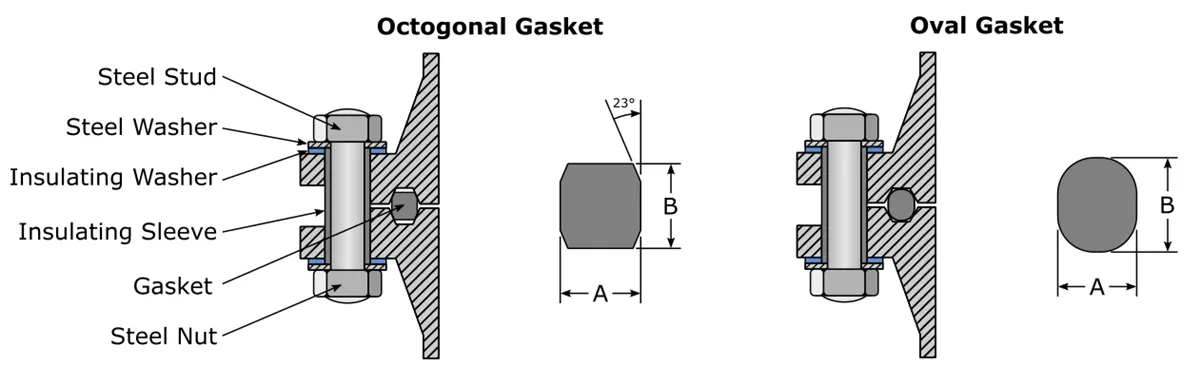
RTJ gaskets are often manufactured from a material slightly softer than that of the flange. Because the gasket material is softer, it deforms at a lower pressure than the flange, this ensures that it is the gasket that deforms to make the seal rather than the flange deforming around the gasket.


